
Designing a professional pharmacy website that stands out is an effective marketing strategy for making your pharmacy more visible. A pharmacy with an ecommerce-enabled website can meet customer needs more efficiently through an online catalogue and cart, attract a larger audience, and increase sales, especially for OTC medications.
An effective pharmacy website design is essential for sharing information, automating sales, and strengthening marketing, among other benefits. Below are the crucial elements and factors your website should incorporate to achieve these objectives.
Elements of a Great Pharmacy Website Design
The ideal website keeps your target audience engaged if you intend to turn them into paying customers.
Here are five essential tips to help you build a brand-focused web design for pharmaceutical companies.
1. User-Friendly, Easy Navigation
When a visitor lands on your website from search engines, or by typing your URL directly into the address bar, they land on your homepage.
What determines how long visitors stay, and whether they explore your products and services, is how easily navigable your site is.
Important pages should be accessible to prospective customers without unnecessary effort or friction.
Your website needs a navigation bar clearly visible at the top of the screen, typically including:
- Blog
- Shop
- Products/Services
- Frequently Asked Questions
- Contact Us
- About Us
Dropdown menus are also worth using to organise subcategories that lead to specific products, services, or news.
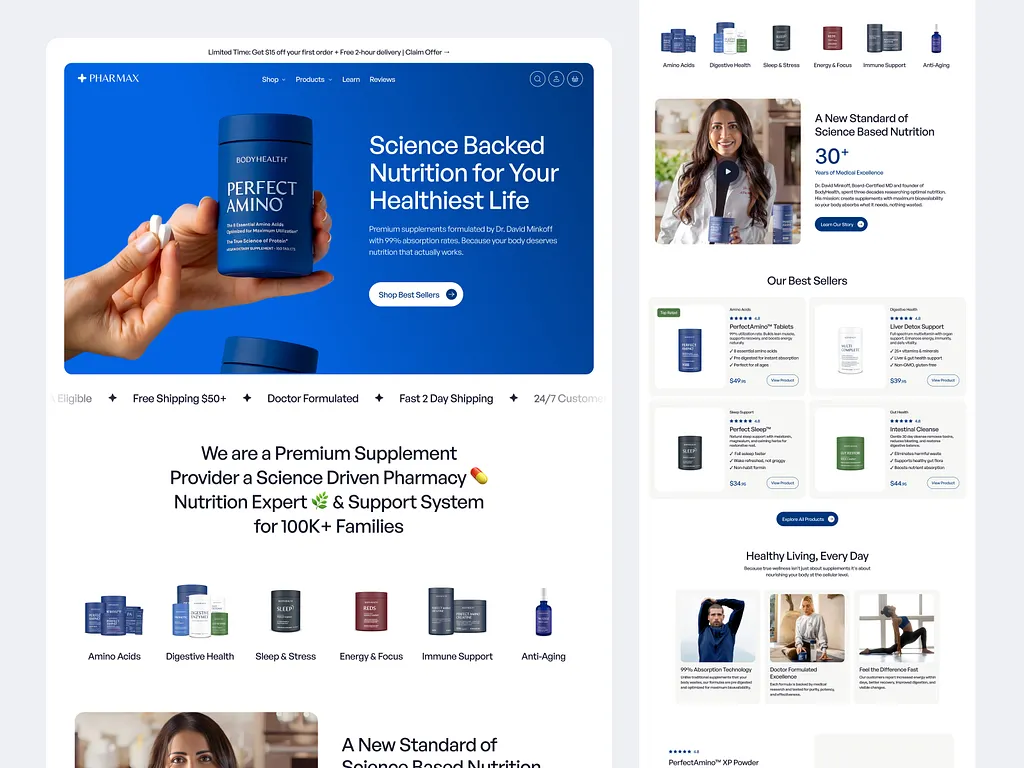
2. Use of Visual Elements (Images & Videos)
Including visual elements like photos, videos, and GIFs plays an important role in the overall credibility of your website.
As a pharmaceutical company, your brand concepts, procedures, and general information need to be communicated clearly, and that’s often best achieved through visually appealing media.
Videos and pictorial representations help visitors absorb information more easily and keep what might otherwise feel like dense pharmaceutical jargon from becoming a barrier.
Relying solely on long blocks of text can become monotonous for readers and may eventually discourage them from reading on.
Break your content into digestible sections, introducing images, videos, and infographics where it makes sense.
For example, an article about a specific health condition could present statistics through a pictorial infographic, the percentage of people affected, the most impacted demographics, or trends observed among users of a particular drug.
Using visuals instead of plain text makes your content clearer and easier to follow.
3. Cohesive Web Architecture
This matters a lot for branding. When users think of your website, they should be able to picture it clearly, tied to the style they associate with your brand.
The theme, colours, and style you use across your website should resonate with and reflect your pharmaceutical company.
Fonts, colour palettes, and other design elements used on the homepage should stay consistent across every page of your site.
For example, if you use hand-drawn or AI-generated imagery on one page, keep that same visual style across the other pages for consistency.
This doesn’t mean every page needs to look identical, just that a common format, style, and theme should run through all of them.
4. Responsive Web Design
Visitors will access your website from a range of devices: mobile phones, tablets, and laptops.
Your pharmaceutical company’s website needs a responsive design that loads content correctly on each device.
Users who visit responsive websites, ones that look good and work well on their specific device, are more likely to return if they find what they’re looking for, and eventually become paying customers.
Beyond the user experience benefit, responsive design also supports better search visibility. Mobile-friendliness is a factor Google and other search engines weigh when ranking pages, so a responsive site gives you a real edge over less responsive competitors.
5. Effective CTAs With Buttons and Forms
At the end of a web page or blog post, visitors often expect a clear next step. A call-to-action button or form does exactly that, guiding prospects toward the action you want them to take.
Buttons and forms play a genuinely important role in pharmaceutical web design. When someone reaches the end of a page, they want to know what to do next, and a well-placed CTA points them in the right direction.
Your CTAs could point visitors to:
- Contact your company
- Sign up for emails and newsletters
- Browse your product catalogue
- Read more blog posts
- View your photo gallery
- Follow you on social media
6. A Genuinely Pleasant Website Experience
A pleasant website user experience (UX) is one of the most reliable ways to catch visitors’ attention and turn them into leads and conversions.
Everything covered above contributes to a pleasant overall experience, though a few more practices help reinforce it.
When someone finds your website for the first time, they’re usually looking for answers to a pharmaceutical-related question. They’ll skim your content first to confirm it’s relevant, and if your copy is intentional and clear, that’s what keeps them engaged.
To create well-optimised content that builds real industry authority, follow these best practices:
- Format text for conciseness and easy scanning
- Publish only fact-checked, well-researched web copy
- Have editors or experienced copywriters handle core pharmacy content, in line with Google’s E-E-A-T principles (Experience, Expertise, Authoritativeness, and Trustworthiness)
- Use subheadings where it helps readability
- Use bullet points and numbered lists
- Incorporate graphics and explanatory imagery
- Follow sound on-page SEO principles
Frequently Asked Questions
Does a pharmacy website need ecommerce functionality?
Not always, but it helps significantly for OTC products. An online catalogue and cart let customers browse and reorder without visiting in person, which can meaningfully grow sales beyond your physical footprint.
Can a pharmacy website sell prescription medication online in Nigeria?
Prescription medication sales are tightly regulated. Speak with the relevant regulatory bodies (such as the Pharmacists Council of Nigeria) before building any online prescription-sales functionality, and keep OTC and prescription workflows clearly separated on your site.
How long does it take to build a pharmacy website?
A well-planned pharmacy website typically takes a few weeks from brief to launch, depending on catalogue size, custom features, and how much content needs to be prepared.
What makes pharmacy web design different from a regular business website?
Trust and accuracy matter more. Visitors are often looking for health-related answers, so content needs to be fact-checked, clearly organised, and ideally reviewed by someone with relevant pharmaceutical expertise.
If growing your pharmacy’s customer base is one of your goals for 2026, we can help you handle the digital side by building a result-focused pharmacy website for your outlet.
Send your brief to info@webdesigns.ng or WhatsApp us on 08114900422.
Need a website that actually grows your business?
Web Design Nigeria builds fast, SEO-ready websites for Nigerian businesses. Let’s talk about yours.