
If you’re worried your website isn’t showing up on Google’s search results, you’re not alone. Plenty of site owners run into this, especially after major algorithm updates that reshape how Google evaluates content quality.
Google indexes an enormous number of pages, reportedly in the hundreds of billions, functioning as a kind of digital librarian for the entire internet. Its search results are built entirely from that index. But despite Google’s efforts to crawl and index the web broadly, plenty of legitimate websites and pages still remain invisible to it.
If your site falls into that category, here’s a systematic look at why, and how to fix it.
Why Isn’t My Website Indexed on Google?
It’s worth noting upfront that newly created websites or pages naturally take time for Google’s crawler to find and index. If your site is only a few weeks old, some delay is completely normal.
But if your website is several months old and still isn’t indexed, it’s time to look at the underlying causes. The good news: most of these issues are identifiable and fixable.
Here are the most common reasons a website fails to get indexed by Google.
1. Your Website Is Genuinely New
New websites take time to index naturally unless you’re proactive about getting indexed faster. Think of a brand-new site as an unfamiliar face in a crowded room, Google needs time to properly catalogue it and understand how to serve it in results.
Indexing and ranking are two different things: a page has to be indexed before it can rank at all. This waiting period is normal, and patience matters here.
If Google is still refusing to index your site after you’ve submitted it through Google Search Console and added your sitemap, move on to the other reasons below, they’re likely more relevant to your situation.
2. Duplicate or Copied Content
Originality matters enormously for visibility, and Google pays close attention to it. Sites publishing copied or duplicated content are treated as lacking authenticity, and Google’s policies reflect that directly.
Such sites can face real consequences, deindexing or an outright refusal to index being among the most common. Google, as the internet’s de facto gatekeeper, treats indexing unoriginal content as a waste of limited crawl resources, particularly when a site has a large volume of low-value pages.
Imagine submitting an essay copied verbatim from someone else’s published work; it earns you nothing. Google prioritises unique content that offers genuinely fresh insight or perspective. Make sure your content stands out and offers something real to the audience you’re actually trying to reach and convert.
3. Poorly Written Content
Content quality matters far more than quantity for SEO. Research consistently shows poorly written content actively hurts Google rankings. It’s genuinely better not to publish new content at all than to publish something mediocre.
If your content reads as a jumble of confusing ideas, Google’s algorithms are likely to treat it as low-relevance, low-value content. It’s like a map with no clear directions, anyone following it will get lost. If your content doesn’t answer users’ actual questions clearly and concisely, Google has little reason to prioritise indexing it.
Well-written, genuinely engaging content that directly addresses audience needs significantly improves your odds of getting indexed, and indexed faster.
4. Not Enough Quality Backlinks

Backlinks function as recommendations from other sites, and Google treats them as one of its most important ranking signals. A site without high-quality, topically relevant backlinks reads to Google as low-value, not worth allocating significant crawl resources to.
Quality matters far more than quantity here. A handful of genuinely authoritative backlinks outweighs a mass of worthless links from link farms or PBNs. Building a real backlink profile is essentially building a web of credibility signals that point back to your site, and that starts with creating content genuinely worth linking to and sharing.
5. Noindex Settings Blocking Your Pages
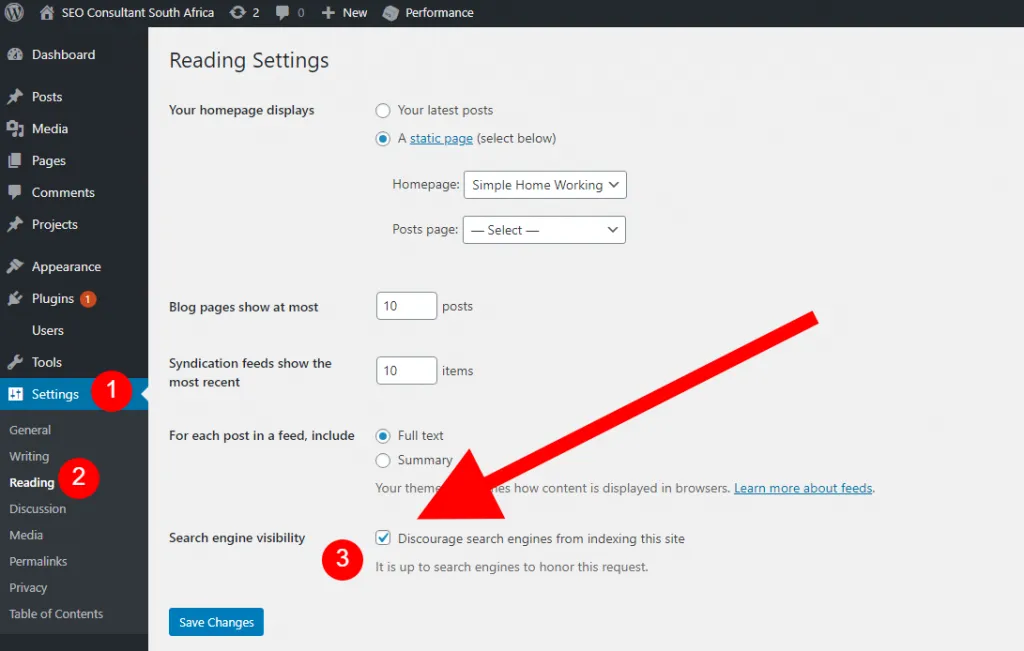
Indexing issues can also come from a purely technical source. If pages on your site are set to “noindex,” it’s the equivalent of a business locking its doors during business hours, Google will honour that instruction and simply won’t display those pages in search results.
Make sure your essential pages are actually set to “index.” In WordPress specifically, check that Settings > Reading > “Discourage search engines from indexing this site” is unticked. It’s a common oversight: developers disable indexing while building a site and forget to re-enable it after launch.
6. Your Website Lacks Authority
Site authority functions as a kind of digital credibility. Without it, ranking well is like trying to be heard in a crowded room with a whisper. Authority is typically measured through metrics like Domain Rating or similar third-party authority scores.
These metrics reflect how well-respected your site is across the web. A genuinely solid backlink profile from authoritative, relevant sources meaningfully boosts this credibility and improves your odds of consistent indexing.
7. Weak Internal Linking
A poorly interlinked website is genuinely frustrating to navigate. Internal links help visitors find relevant information within your site, and search engines use those same links to understand your content hierarchy and what pages you consider most important.
Think of internal links as pathways guiding both users and search bots through your site. Keep them natural, not overdone, linking only to genuinely relevant pages using descriptive, relevant anchor text.
8. Low-Quality or Toxic Backlinks

Not all backlinks carry equal weight. High-quality backlinks function as genuine endorsements; spammy, low-quality ones offer little to no value and, at volume, can raise real red flags with Google.
Participating in link farms or manipulative link-building schemes risks direct penalties. It’s also possible a competitor has targeted you with negative SEO tactics; if you’re not actively monitoring and countering this, your own SEO effort can get quietly sabotaged.
Regularly audit your backlink profile for toxic links, and use Search Console’s disavow tool at the domain or page level where needed. If you’re not confident doing this yourself, bring in an experienced SEO professional rather than risking it.
9. Content Doesn’t Match Search Intent
Google’s core mission is surfacing the most relevant result for a given query. If your content doesn’t align with what users actually intend when they search, Google has no reason to show it.
If your site sells running shoes but your content is about gardening tools, that’s a clear intent mismatch. Make sure your content genuinely reflects what your target audience is searching for; this materially improves your odds of being indexed for the searches that actually matter to your business.
10. A Google Penalty

Google actively enforces policies against sites that violate its guidelines, and violations can result in penalties. There are two broad categories: manual penalties, applied deliberately by a human reviewer, and algorithmic penalties, triggered automatically by practices that manipulate rankings.
Google can reconsider indexing your site once you’ve genuinely fixed the underlying issue that triggered the penalty.
11. Targeting Keywords That Are Too Broad or Competitive
Extremely broad, highly competitive keywords are genuinely difficult to rank for, especially for a newer or smaller site. The competition is often too intense to break through early on.
Instead of chasing broad, short-tail keywords, target more specific, lower-competition terms aligned closely with your actual prospective customers. This tends to deliver far better results, faster.
12. Poor User Experience
Slow-loading pages, confusing site structure, and unengaging content with convoluted navigation all push users to leave and never return. Google notices this too.
Google favours sites that keep users engaged, deliver real value, and offer smooth navigation. A poor user experience doesn’t just hurt satisfaction, it directly affects how your site gets indexed and ranked over time.
Working through these factors systematically genuinely improves your odds of getting recognised and indexed by Google, and ultimately strengthens your overall online presence. For deeper strategy once you’re indexed and ranking, see our guides on SEO strategies to boost web traffic and local SEO for Nigerian businesses.
Reliable SEO Services in Nigeria
We’re a reliable partner for solving real SEO and indexing problems, not just diagnosing them. Our SEO services include:
- Keyword opportunity analysis
- Technical site audits
- Content strategy and creation
- Proper site architecture
- Competitor analysis
- Ongoing SEO maintenance and support
- SEO-focused web design
- Off-page and on-page optimisation
- Keyword strategy
- Real-time metrics, testing, analytics, and reporting
Frequently Asked Questions
How long does it take for a new website to get indexed by Google?
Typically a few days to a few weeks for a healthy, well-structured site, though it can take longer without a submitted sitemap or any inbound links pointing to it.
How do I check if my website is indexed on Google?
Search “site:yourdomain.com” directly in Google, or check the Pages report in Google Search Console, which tells you exactly which pages are indexed and why others aren’t.
Can a website recover after being deindexed by Google?
Yes, in most cases. Once you identify and fix the underlying issue, duplicate content, a penalty, a technical noindex tag, Google will typically re-crawl and re-index the site over time.
Does site speed really affect whether Google indexes my pages?
Indirectly, yes. Slow sites get crawled less efficiently and provide a worse user experience, both of which affect indexing priority and rankings over time.
Want help diagnosing exactly why your site isn’t showing up on Google? Send your brief to info@webdesigns.ng or WhatsApp us on 08114900422.
Need a website that actually grows your business?
Web Design Nigeria builds fast, SEO-ready websites for Nigerian businesses. Let’s talk about yours.